
Process diagnostic
Find where AI pays off in your processes.
Your team answers. You review. You get the processes that fit, ranked, each tied to the answers behind it.
How it works
Three steps. Your team does the answering.
- 01
Your team answers
Each person gets questions for their role. A rapid pass takes 5 to 8 minutes.
Rapid, standard or extended - 02
You review
Approve, edit or reject every finding before anything is built.
Nothing counts until you approve - 03
You get the package
Ranked opportunities, each tied to the answers behind it.
Priced up front
Choose the mode
Pick the depth, the function and who answers.
per respondent
per respondent
per respondent
Eight functions, 29 process groups
- Finance
- Human resources
- Procurement
- Sales
- Customer service
- Operations
- IT
- Risk and compliance
Such as accounts payable, recruitment, case management or internal audit.
Five roles answer
- Process owner
- Process operator
- Approver
- Control owner
- Internal customer
Each role gets its own questions.
A real report
What comes back.
A sample audit of a fictional accounts-payable team. Yours is built from your team's answers.
 123
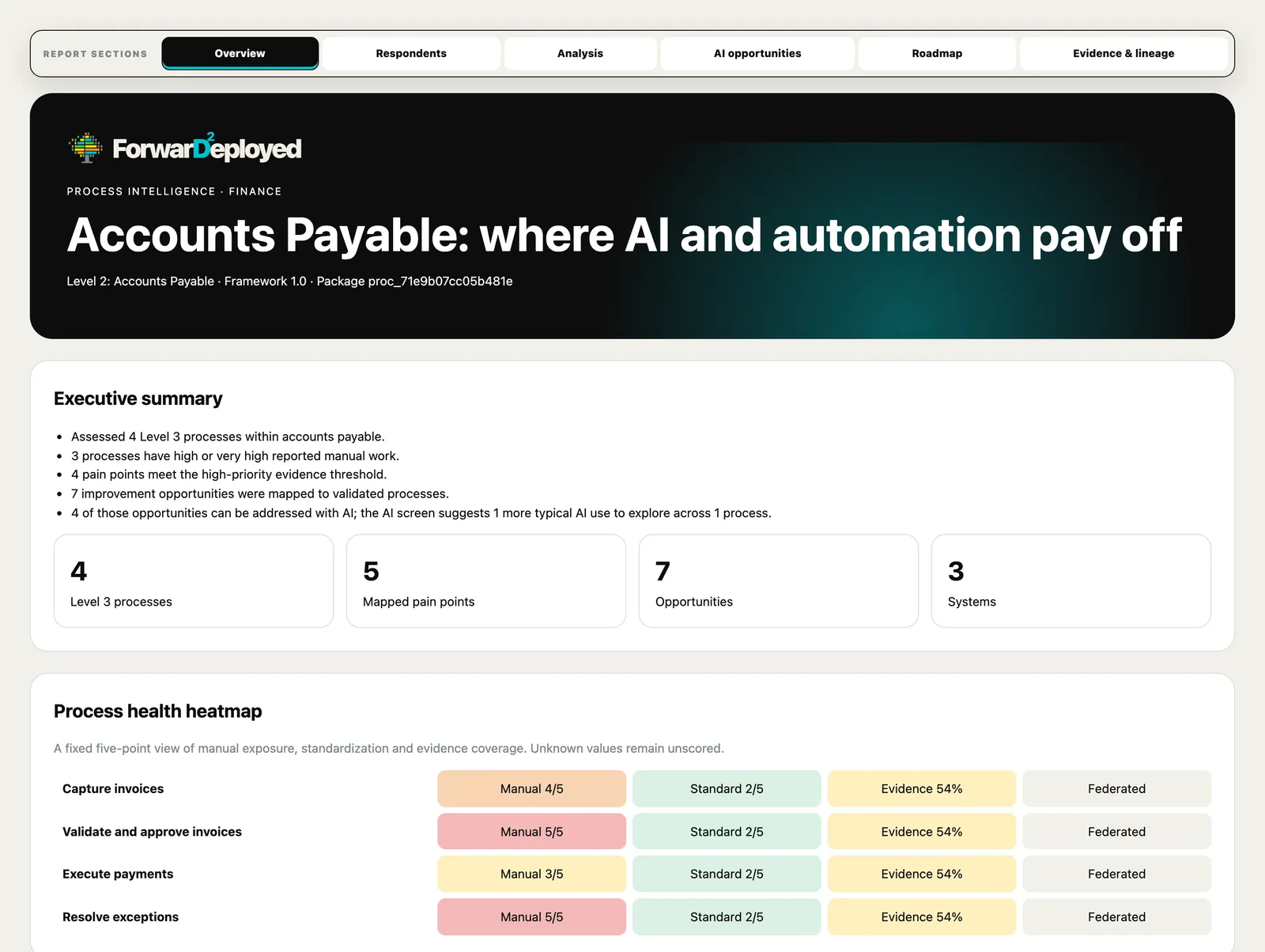
- Executive summary in five lines.
- The counts that frame the audit.
- Heatmap: manual work, standardization and evidence, process by process.
 123
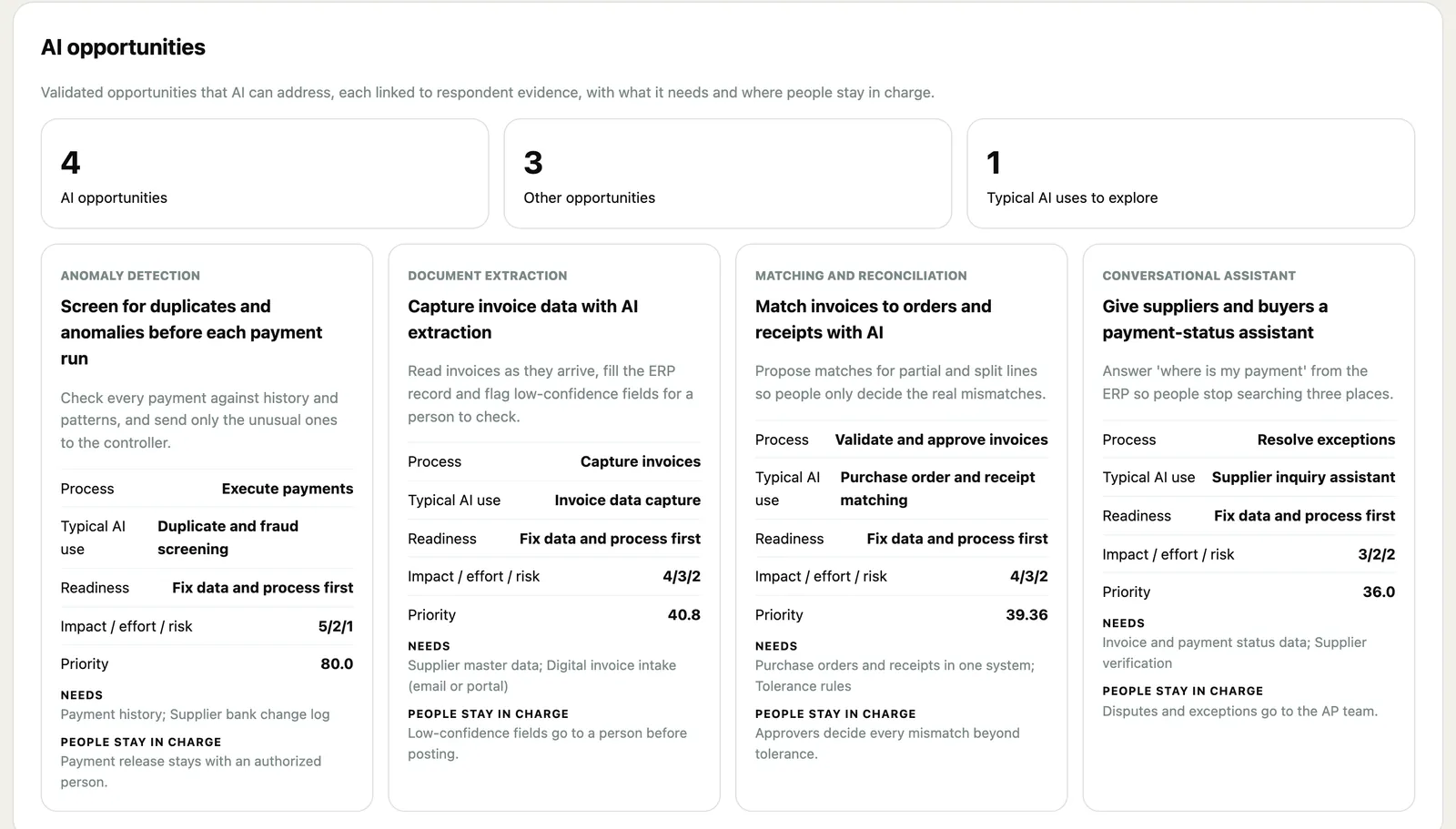
- 4 AI opportunities, 3 other fixes, 1 more to explore.
- Each names its process, readiness and a priority score.
- What it needs, and where people stay in charge.
 12
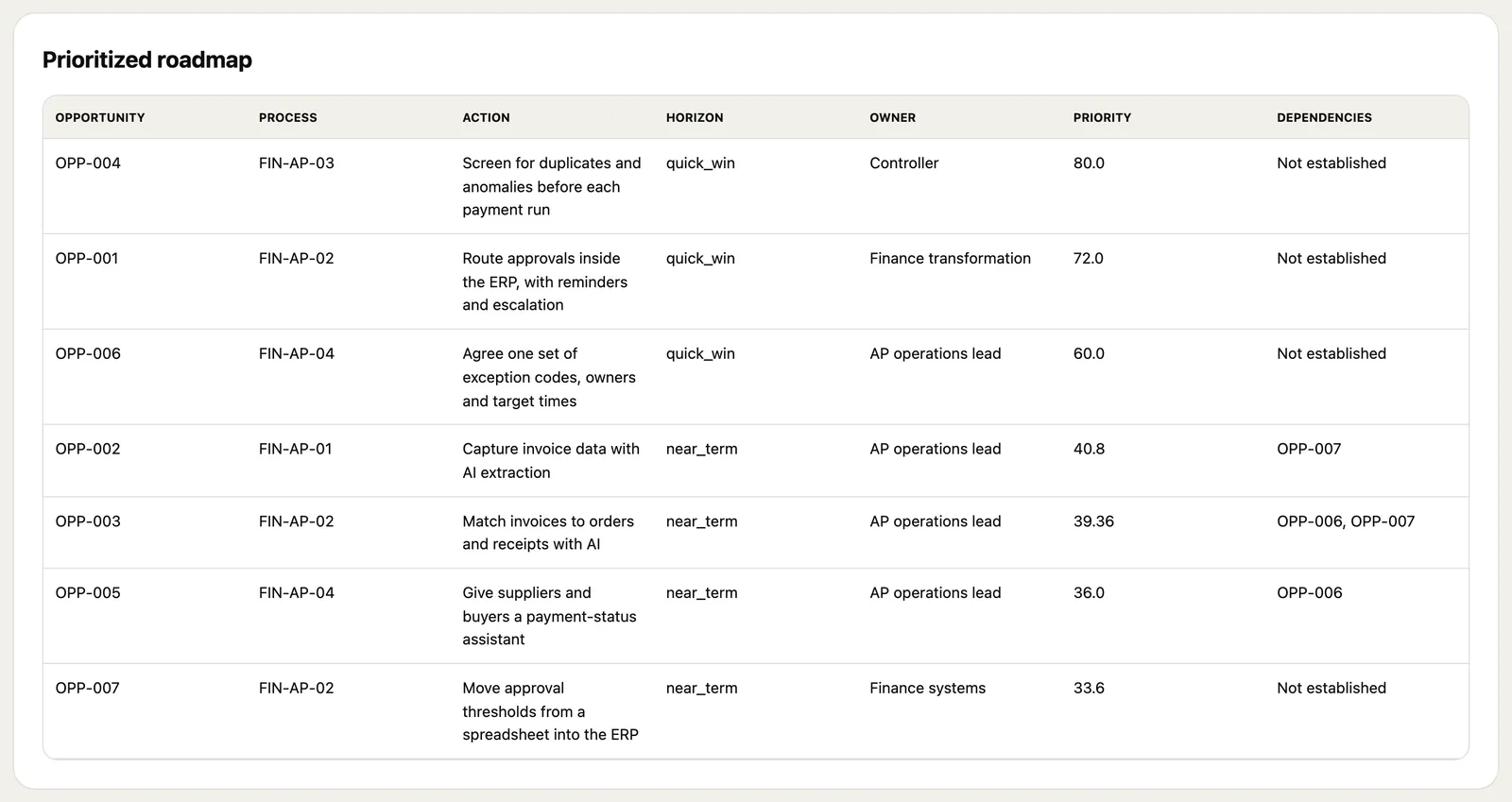
- Ordered by priority score.
- Each with an owner and what it depends on.
The same package, in four files
- Excel19 sheets
Summary, pain points, opportunities, evidence and the roadmap.
- PowerPoint16 slides
Action titles, ready to present.
- WordFull report
Findings, root causes, roadmap and method.
- InteractiveTabs, as above
Click through to the evidence behind any finding.
The brain
What you approve is remembered.
Findings you approve become part of your organisation's memory: a map that links each finding to the exact answers behind it and to the processes it concerns.
- Only approved findings go in. Rejected ones never do.
- Replaced findings are kept in history, not overwritten.
- Looked up by relevance and recency, only inside your organisation.
- Answers stay anonymous: respondents appear as numbers.
 12
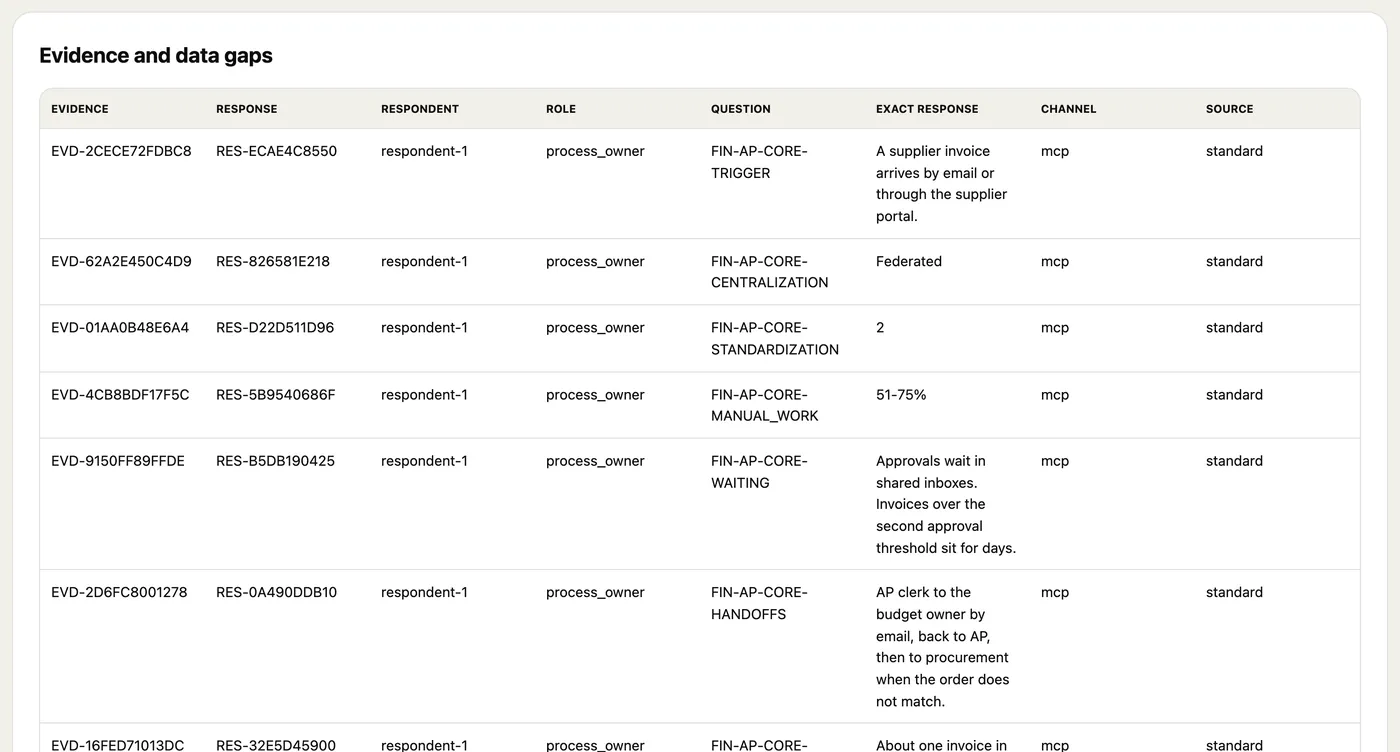
- Evidence IDs tie a finding to a response.
- The exact words, never rewritten.
Try it in Claude, ChatGPT or any AI assistant: Audit my finance function for AI opportunities.